
The migration in short
The six questions we are asked most often.
When is it?
All year. It never stops, only the location changes.
Calving season?
Late January to February, in Ndutu.
River crossings?
July to October at the Mara, in the north.
Where do I stay?
Ndutu Dec–Mar, Kogatende Jul–Oct. It matters enormously.
How many nights?
Three minimum in the migration area.
Guaranteed crossing?
No. Anyone promising one is overselling.
What the Great Migration actually is
The Great Migration is the year-round movement of roughly 1.3 million wildebeest, 250,000 zebra and several hundred thousand Thomson's and Grant's gazelle around the Serengeti–Masai Mara ecosystem. It is the largest overland movement of animals left on earth.
The single most useful thing to understand is this: it is not an event with a date. The herds are somewhere in the ecosystem in every month of the year, moving in a roughly circular route driven by rainfall and the growth of new grass. There is no start and no finish. What changes month by month is where they are, and therefore where you need to be.
A second thing worth knowing: the wildebeest do not travel as one enormous herd. They move in long columns and scattered groups spread over tens of kilometres, sometimes converging into the dense masses that appear in documentaries, sometimes dispersed across open plain. Both are the migration.
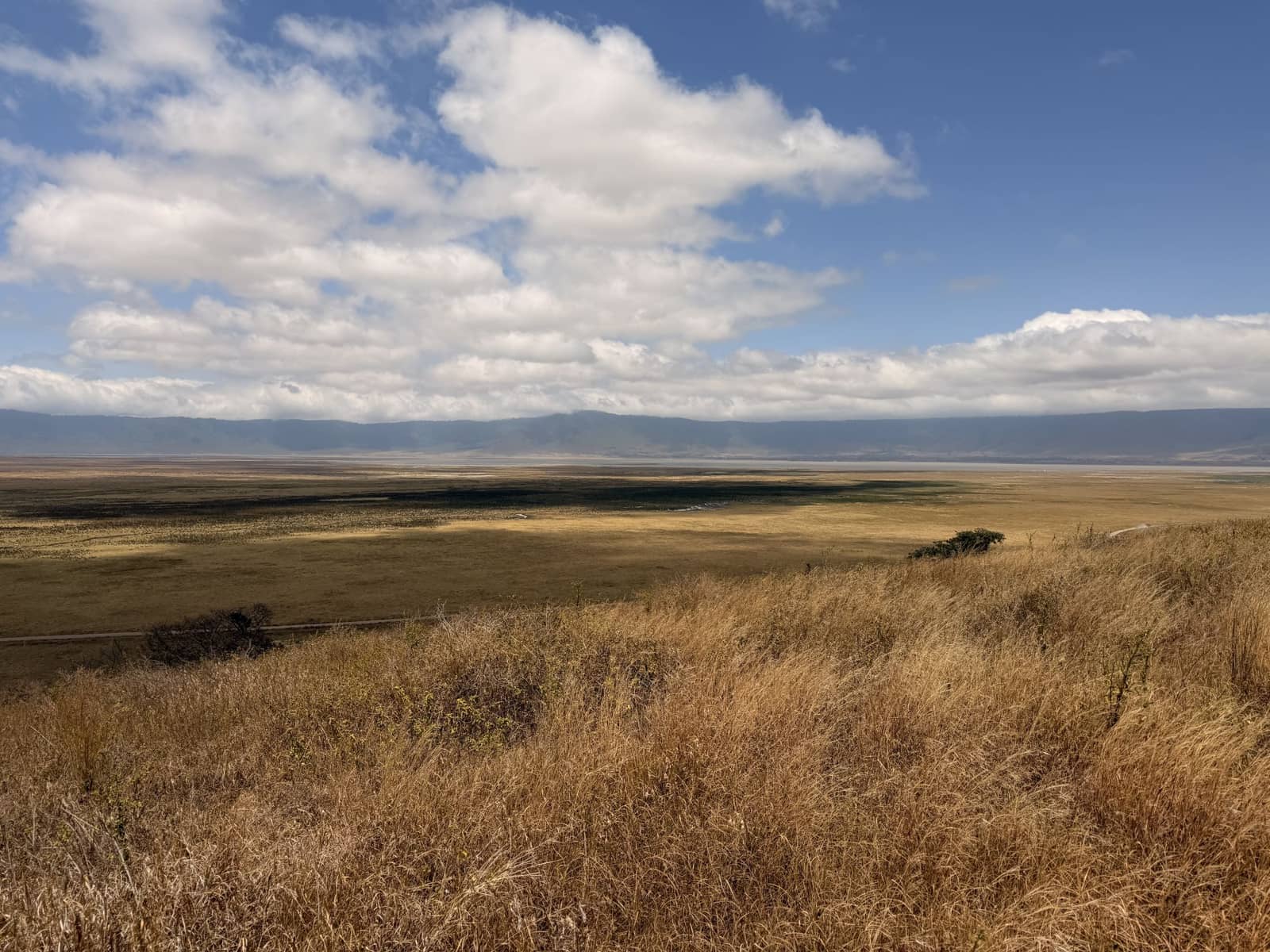
Month by month: where the herds are
The pattern below repeats every year, but rainfall shifts it by two or three weeks in either direction. Treat it as a strong probability, never a timetable.
| Month | Where the herds are | What is happening | Stay at |
|---|---|---|---|
| January | Southern plains & Ndutu | Herds settle on the short-grass plains. Calving begins late in the month. | Ndutu |
| February | Ndutu & southern Serengeti | Peak calving. Up to 8,000 births a day in a three-week window. Predator activity at its highest of the year. | Ndutu |
| March | Southern plains, starting to move | Calves strengthening. Long rains begin; the herds start drifting north-west. | Ndutu / Seronera |
| April | Central & western Serengeti | Long rains. Columns form and move. Green, dramatic, almost empty of tourists. | Seronera / Moru |
| May | Western Corridor | Rut: males fighting for mating rights. Long columns heading west. | Western Corridor |
| June | Western Corridor & Grumeti River | Grumeti crossings. Smaller than the Mara but with enormous crocodiles and very few vehicles. | Western Corridor / Grumeti |
| July | Northern Serengeti | Herds reach the Mara River. First crossings, often tentative. | Kogatende |
| August | Northern Serengeti & Masai Mara | Peak Mara River crossings. The most frequent and dramatic of the year. | Kogatende |
| September | Northern Serengeti & Mara | Crossings continue in both directions as herds move back and forth across the river. | Kogatende |
| October | Northern Serengeti, drifting south | Last crossings. Herds begin the return journey down the eastern Serengeti. | Kogatende / Lobo |
| November | Eastern & central Serengeti | Short rains pull the herds south. Long columns through Lobo and Seronera. | Lobo / Seronera |
| December | Southern plains | Arrival on the short-grass plains. The circuit begins again. | Ndutu / Seronera |
The calving season: the part most people miss
Between late January and February, around 400,000 wildebeest calves are born on the short-grass plains around Ndutu, with a peak of up to 8,000 births in a single day. Roughly 80% of the females give birth within the same three-week window.
Why they all give birth at once
It is a survival strategy called predator swamping. By flooding the plains with newborns in a concentrated burst, the herd guarantees that predators cannot possibly take them all. The lions, hyenas and cheetahs are simply overwhelmed. A calf born outside that window is far more likely to be killed.
Why Ndutu specifically
The southern plains sit on volcanic ash blown from the Ngorongoro highlands, which created a hardpan close to the surface. Trees cannot root through it, so the plains stay open (good visibility against predators), and the short grass that grows there is unusually rich in calcium and phosphorus. It is exactly what a nursing mother needs to build bone in a calf.
What you actually see
Newborns standing within minutes of birth and running within the hour. Nursery groups of hundreds of calves. And, inevitably, predation: this is the month when lion, cheetah and hyena hunt most successfully, and you will see kills. Some travellers find that difficult, so it is worth knowing in advance.
The river crossings, and the truth about them
The image everyone has of the migration, thousands of wildebeest plunging into a river while crocodiles wait, is real, and it happens at the Mara River in the northern Serengeti between July and October, and at the Grumeti River in the west around June.
What actually happens
Herds gather on the bank, often in their thousands. They wait. Sometimes for twenty minutes, sometimes for six hours, sometimes all day. Then one animal commits and the rest follow in a few frantic minutes, or the whole herd turns around and walks away without crossing at all.
Nobody controls this and nobody can predict it. Herds have been known to cross, graze on the far bank for an hour, and cross straight back.
The honest odds
With three nights at Kogatende between late July and September, you have a good chance of witnessing at least one crossing. With one night, you are gambling. Any operator who guarantees a crossing on a specific date is either misinformed or selling you something they cannot deliver.
Grumeti vs Mara
| Mara River | Grumeti River | |
|---|---|---|
| Months | July – October | May – July |
| Scale | Large, dramatic | Smaller, more scattered |
| Crocodiles | Many | Fewer but enormous |
| Vehicles | Many in peak season | Very few |
| Where to stay | Kogatende | Western Corridor |
Where to stay for each phase
This is where most migration trips go wrong. Booking "a lodge in the Serengeti" is not enough: the park is 14,763 km², and a lodge in the centre is a five-hour drive from the herds if they are in the north.
| If you travel in… | Stay in… | Why |
|---|---|---|
| December – March | Ndutu | Calving season on the southern plains |
| April – May | Seronera / Moru | Herds moving through the centre and west |
| May – July | Western Corridor | Grumeti River crossings |
| July – October | Kogatende | Mara River crossings in the north |
| November | Lobo / Seronera | Return journey through the east |
Mobile camps
Several operators run mobile tented camps that physically relocate two or three times a year to follow the herds. They are the most reliable way to stay close to the migration, they are usually small and remote, and they cost roughly $300–700 per person per night. If the migration is the entire point of your trip, this is what you want.
How to plan a migration safari
Step 1: decide which phase you want
Calving in Ndutu, or river crossings in the north. These are the two headline experiences and they happen at opposite ends of both the park and the calendar. You cannot do both in one trip.
Step 2: book early
Camps in Kogatende for August and September, and in Ndutu for February, sell out six to twelve months ahead. This is not a sales tactic. Those areas have limited beds, and the good small camps go first.
Step 3: give it enough nights
Three nights minimum in the migration area. Two is a gamble, one is a lottery ticket.
Step 4: consider flying
Kogatende is a two-day drive from Arusha. A 1 hour 15 minute flight converts four days of driving into four more days of game viewing. For a northern-Serengeti trip, flying is almost always the right call.
Step 5: build in the rest of the ecosystem
The migration is not the only thing worth seeing. Resident predators, the Ngorongoro Crater and Tarangire's elephants are all there regardless of where the herds are, and a good itinerary uses them to fill the days around your migration nights.
| Trip length | Suggested shape |
|---|---|
| 5 days | Fly in to the migration area for 3 nights, Ngorongoro on the way out |
| 7 days | Tarangire, Serengeti central 2 nights, migration area 3 nights, Ngorongoro |
| 10 days | Full northern circuit with 4 nights in the migration area, then Zanzibar |
Five things people get wrong
1. "The migration happens in August"
The Mara River crossings happen around August. The migration itself is continuous. The herds are always somewhere, and there is no month when nothing is happening.
2. "I need to go to Kenya to see it"
Around 80% of the migration's annual circuit is inside Tanzania. The herds spend roughly two to three months in the Masai Mara and the rest of the year in the Serengeti ecosystem.
3. "A crossing is guaranteed if I go at the right time"
It is not. Being in the right place in the right month gives you a good chance over several days. It gives nobody a guarantee on any single morning.
4. "The migration is one giant herd"
It is columns and scattered groups spread over tens of kilometres, sometimes converging and sometimes dispersed. The documentary shot of a solid mass is one moment, not the normal state.
5. "The rainy season is a bad time"
April and May are green, dramatic, almost empty of other vehicles and considerably cheaper, and the herds are moving through the centre and west, which is perfectly good viewing. If your priority is value and solitude rather than river crossings, the wet months are underrated.
The Great Migration: frequently asked questions
It depends which phase you want. Late January to February for the calving season in Ndutu; July to October for the Mara River crossings in the northern Serengeti. Both are exceptional, and they happen at opposite ends of the park and the calendar.
Yes. The herds never leave the ecosystem. They move in a continuous circuit. What changes is where they are, so the region you stay in must match your month.
No, and be sceptical of anyone who promises one. Herds can wait on the bank for a full day and then walk away. Three nights at Kogatende between late July and September gives you a good chance, not a guarantee.
Around 80% of the annual circuit is in Tanzania. The herds spend only two to three months in the Masai Mara. Tanzania also gives you the calving season, which Kenya does not.
Ndutu, on the southern short-grass plains, between December and March. Note that Ndutu is technically inside the Ngorongoro Conservation Area rather than the Serengeti, though ecologically it is the same plain.
Three nights minimum in the migration area itself, plus travel days. Two nights is a gamble and one is a lottery ticket. Five to seven days total makes a comfortable trip.
Around 1.3 million wildebeest, plus roughly 250,000 zebra and several hundred thousand gazelle. It is the largest overland movement of animals remaining on earth.
A tented camp that physically relocates two or three times a year to follow the herds. It is the most reliable way to stay close to the migration, typically $300–700 per person per night, and usually small and remote.