
What is the Ngorongoro Crater?
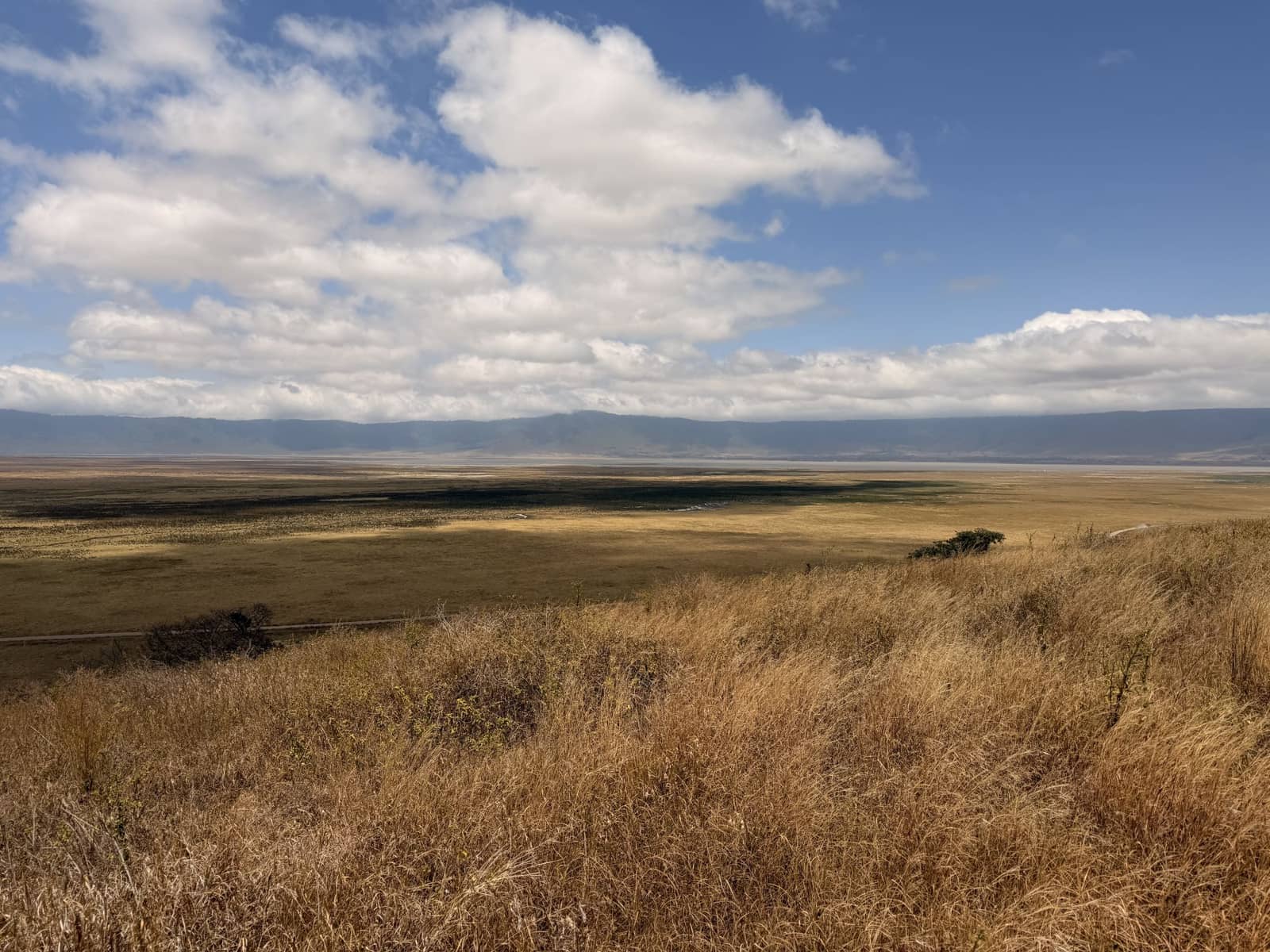
The Ngorongoro Crater is the largest intact volcanic caldera on earth: a bowl 19 km across, 610 m deep and 260 km² in area, with walls that rise almost vertically from the floor. Around 25,000 large animals live inside it permanently, giving it the highest density of big game anywhere in Africa.
The crater sits within the much larger Ngorongoro Conservation Area, 8,292 km² of highlands, forest and plains that also contains Olduvai Gorge, the Empakaai and Olmoti craters, and the Ndutu plains where the Great Migration calves. It is a UNESCO World Heritage Site and unusual in Africa for being a multiple-use area: around 100,000 Maasai live here with their cattle alongside the wildlife.
For most visitors one fact settles it: this is the most reliable place in Tanzania to see black rhino, and therefore the place where completing the Big Five in a single day is genuinely possible.
The crater vs. the wider Conservation Area
People often say "Ngorongoro" to mean two different things. Here is the distinction, and why it matters for your itinerary.
The crater floor
The 260 km² caldera itself: a self-contained bowl where most of the animals live year-round because the walls keep them in. This is what almost everyone means when they say "Ngorongoro Crater", and it is where you spend your game-drive day.
The Conservation Area
The full 8,292 km² region surrounding the crater: highlands, forest, the Ndutu plains and two further craters, Empakaai and Olmoti. It is a UNESCO-listed multiple-use area where roughly 100,000 Maasai live alongside the wildlife, unlike a national park where people are excluded.
Olduvai Gorge
Half an hour from the crater, on the road to the Serengeti, Olduvai Gorge cuts 90 m through two million years of volcanic sediment. Louis and Mary Leakey worked here from the 1930s and found hominin remains that reshaped what was known about human origins, including Paranthropus boisei in 1959. There is a small museum, and it fits easily into the drive between Ngorongoro and the Serengeti.
The Maasai who live here
Ngorongoro is not a national park, and the distinction is deliberate.
When the Serengeti was gazetted in 1959 the Maasai living there were moved out; Ngorongoro was created as a multiple-use conservation area where people, livestock and wildlife share the land. Around 100,000 Maasai live in the Conservation Area today with roughly a million head of cattle, grazing the crater floor by day and returning to the rim at night.
Visiting a Maasai boma is possible and is arranged through the conservation authority. Quality varies. Some visits are heavily staged. We work with communities we have long relationships with, where the fee reaches the village and you can genuinely ask questions.
Wildlife: what you will actually see
Sighting probabilities for a single full day on the crater floor. Unusually high, because the animals cannot disperse.
Lion, buffalo, elephant and black rhino are all realistic on a single crater day: a genuine chance at the Big Five in 24 hours, which is unusual anywhere in Africa. Only leopard is a real long shot: they live in the rim forest and are seldom seen from the floor. There are no giraffe at all: the descent roads are too steep for them.
The crater lions are among the most studied in the world and illustrate the cost of isolation: the population is effectively closed, genetic diversity is low, and a disease outbreak in 1962 reduced them to a handful of animals. Numbers today sit around 60, and they are highly habituated to vehicles. Around 30 black rhino live in the crater under round-the-clock ranger protection, usually seen at a distance across open grass, so bring binoculars.
When to visit
The crater works in every month. The animals do not migrate out, so unlike the Serengeti there is no wrong season for game viewing.
June to October is driest, coldest at dawn and busiest: expect other vehicles at every sighting. March to May brings the long rains: slippery descent roads and mist that can sit on the rim until mid-morning, but also the greenest crater and the cheapest rates.
More important than the month is being on the floor at 06:30. Predators are active in the first two hours, the light is soft, and you are ahead of the vehicles that descend at nine. This single decision changes the quality of the day more than the season does.
Where to stay
Three broad choices, and the decision is mostly about how early you can be at the descent gate.
Budget
from $35.40/night camping fee
Simba public campsite, on the rim itself: your own tent, basic shared facilities, and buffalo or zebra sometimes wandering through camp at night. Cold at 2,400 m: a proper sleeping bag is not optional.
Karatu
$60–200/night
A real town 30–45 minutes from the gate: far better value, warmer, more choice of restaurants. The trade-off is an early start, leaving around 05:30 to be first at the descent road.
Crater rim lodge
$250–800+/night
The view straight down into the crater from your room, and ten minutes from the descent road so you can be first onto the floor. Expensive, cold at night, and often booked out months ahead.
If you are visiting for one day only and cost is not the deciding factor, stay on the rim. Being first onto the floor is worth a great deal. If you have several days in the area, Karatu is the sensible base and the money saved can pay for an extra night in the Serengeti.
Park fees (2026)
Ngorongoro is administered by the NCAA, not TANAPA, and it has one charge that catches people out: a separate fee simply to drive down into the crater, charged per vehicle rather than per person.
| Category | Adult (16+) | Child (5–15) |
|---|---|---|
| Conservation Area entry, per 24 hours | $82.60 | $23.60 |
| Crater service fee (descent, per vehicle) | $295.00 per vehicle | |
| Concession, sleeping inside the NCA (per night) | $59.00 | $11.80 |
| Public campsite (per night) | $35.40 | $5.90 |
All figures include 18% VAT. Children under 5 enter free. The crater descent fee is per vehicle, not per person, so the cost per head drops sharply with group size: roughly $148 each for two people, under $50 each for six. It applies every time you descend, so a second crater day means paying it twice. Fees can change without notice; your written quote always states the exact amount for your dates.
Ngorongoro in pictures


Ngorongoro Crater: frequently asked questions
In 2026, $82.60 per adult per 24 hours to enter the Conservation Area, plus a crater service fee of $295.00 per vehicle for the descent. Children 5–15 pay $23.60; under-fives are free. All figures include 18% VAT.
It is charged per vehicle rather than per person and funds conservation and the rhino protection programme. Because it is per vehicle, the cost per head drops sharply with group size: around $148 each for two people, under $50 each for six.
Around 30 live in the crater and the odds on a full day are roughly 60%, but usually at a distance across open grass. Bring binoculars. Early morning gives the best chance, before they retreat towards the swamp margins.
In Ngorongoro this is genuinely possible, which is unusual. Lion, buffalo and elephant are near-certain, rhino is likely, and only leopard is a real long shot: they live in the rim forest and are seldom seen from the floor.
Six hours from the moment you descend. The limit is enforced at the exit gate and exists to control vehicle numbers on a small floor.
About 180 km, three to four hours by road. Yes, a day trip is possible, leaving around 05:30 and returning after dark, and it remains one of our most requested one-day safaris, since it lies directly on the route to the Serengeti.
The crater is the 260 km² caldera floor. The Conservation Area is the 8,292 km² region surrounding it, which also includes Olduvai Gorge, the Empakaai and Olmoti craters, the Ndutu plains and around 100,000 Maasai residents.
Rim lodges cost $250–800 and let you be first onto the floor. Karatu costs $60–200 and adds a 30–45 minute pre-dawn drive. For a single crater day the rim is worth it; for longer stays Karatu is the better value.