
Serengeti or Ngorongoro, in short
The headline differences before the detail.
Which is bigger?
The Serengeti, by far: 14,763 km² against the crater's 260 km².
Which has rhino?
Ngorongoro. The Serengeti has almost none.
Which has the migration?
The Serengeti, most of the year. Ngorongoro only sees it briefly.
Which takes less time?
Ngorongoro, one full day covers the crater.
Which costs more?
Ngorongoro, once you add the $295 crater descent fee.
Can I do both?
Yes, and most itineraries do. They are next door to each other.
The short answer
They are not really competitors. Most itineraries visit both, because they sit next to each other and do different jobs. The Serengeti is vast, varied, and home to the Great Migration for most of the year. The Ngorongoro Crater is small, self-contained, and delivers the densest concentration of wildlife in Africa in a single day, including the black rhino the Serengeti largely lacks.
If you can only choose one: pick the Serengeti for scale and the migration, pick Ngorongoro if your time is very short and you want maximum wildlife per hour.
Side by side
| Factor | Serengeti | Ngorongoro |
|---|---|---|
| Size | 14,763 km² | 260 km² (crater floor) |
| Established | 1951 | 1959 |
| Status | UNESCO World Heritage Site | UNESCO World Heritage Site |
| Entry fee (2026) | $82.60 / 24h | $82.60 / 24h + $295 per vehicle to descend |
| Best for | Scale, variety, the migration | Density, rhino, a single unforgettable day |
| Lions | ~3,000 | ~60 (in 260 km²) |
| Black rhino | — | ~30 |
| Typical visit length | 2–4 nights | 1 full day |
Figures from our own park guides. See the full Serengeti and Ngorongoro pages for detail.
What the Serengeti does best
The Serengeti is Tanzania's flagship park for a reason: it is enormous, ecologically varied, and holds one of the highest lion densities in Africa. It is also the year-round home of the Great Migration. The herds are somewhere inside the ecosystem in every single month, moving in a continuous circuit driven by rainfall.
What it does not have: meaningful numbers of black rhino, and a genuinely private feeling in peak season near the popular central areas. Full Serengeti park guide →
What Ngorongoro does best
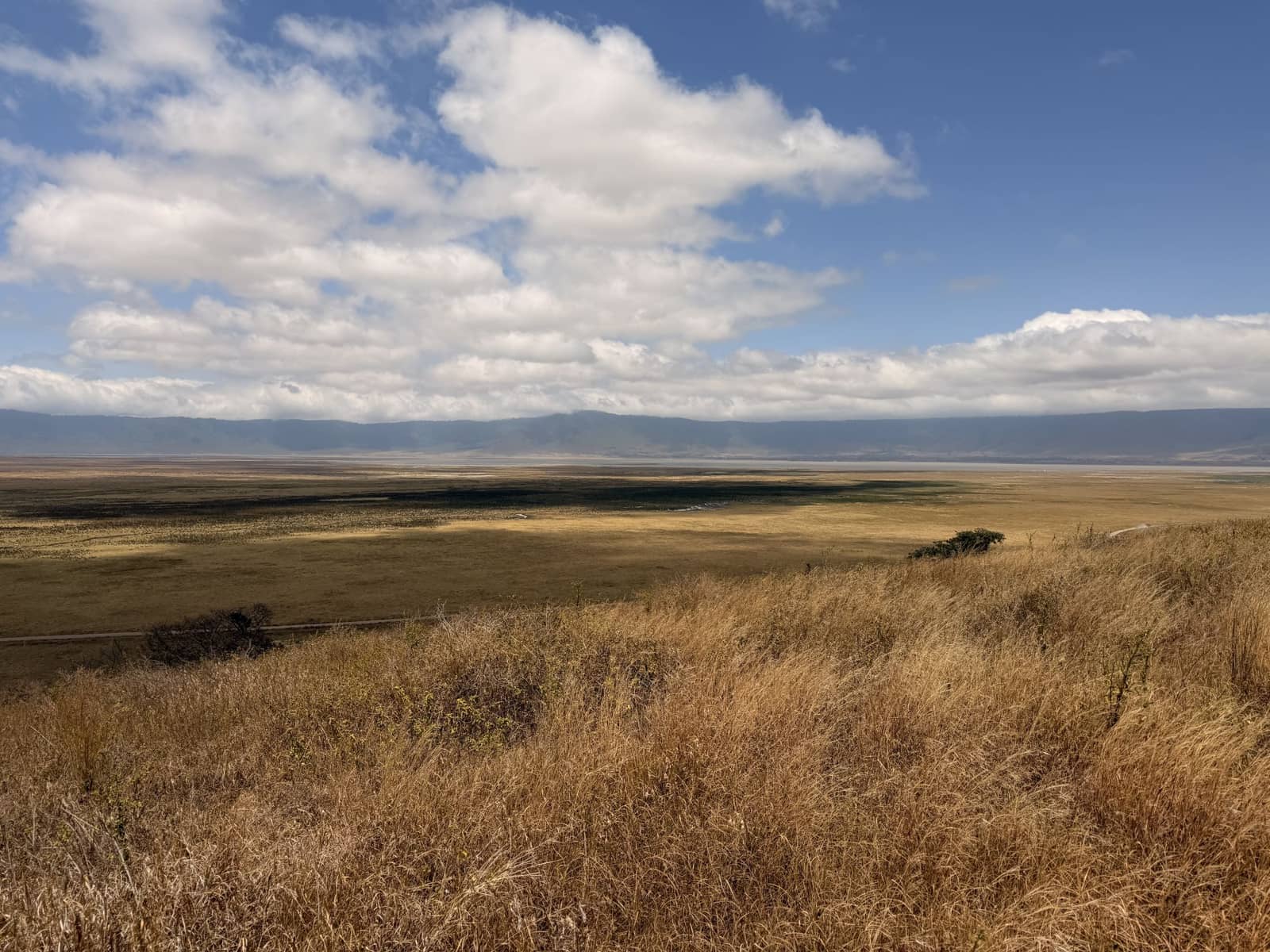
The Ngorongoro Crater is a collapsed volcanic caldera, 260 km² of grassland walled in by a 600-metre rim. Nothing migrates out, so wildlife density is extraordinary. Roughly 25,000 large animals live inside it year-round, visible from a single day's game drive.
What it does not have: the Serengeti's scale, or the migration for most of the year. Ngorongoro is technically part of the same ecosystem (the calving grounds at Ndutu sit inside the Conservation Area), but the crater floor itself sees the herds only briefly. Full Ngorongoro park guide →
Why most people do both
The two parks are adjacent, connected by a short drive, which is why the vast majority of northern-circuit itineraries combine them rather than choosing one. A typical shape: two or three nights in the Serengeti for the space and variety, then one night at or near the crater rim for an early descent the following morning. The crater is best done at first light, before the day-trippers arrive from Karatu.
Our own <strong>5-Day Serengeti & Ngorongoro Safari</strong> is built around exactly this combination.
Serengeti vs Ngorongoro: frequently asked questions
No, they are separate protected areas administered differently (the Serengeti by TANAPA, Ngorongoro by the NCAA), though they are ecologically connected and adjacent to each other.
Together, not separately. The Serengeti gives you lion, leopard, elephant and buffalo easily; Ngorongoro is essentially the only reliable place in Tanzania for black rhino. Visiting both is how most travellers complete the set.
One full day covers the crater floor thoroughly. It is small enough that a single game drive, done early, sees most of what there is to see.
Two to four nights minimum to appreciate its scale. Which region you stay in should match the month, since the migration moves through different parts of the park across the year.
The $295 crater descent fee, charged per vehicle every time you go down. Spread across a group it becomes reasonable, roughly $50 each for six people, but for two people it is a real cost on top of standard park entry.
Yes. If your time is very short, Ngorongoro alone delivers dense wildlife viewing in a single day. If you have a week or more, the Serengeti alone gives you scale and variety. Most travellers with 4+ days do both.